



As the co-designers of Perspectives, we decided it would be appropriate to write our sections for this designer diary separately, each recounting the experience from our own perspective.
We agreed that we would not edit out any discrepancies. If there are any inconsistencies or differences of opinion about what happened, it’s because that’s how life – and co-designing – works. People see and remember things in different ways, so here are two perspectives on designing Perspectives.
Matt & Dave
Matt:
Inspiration can strike from anywhere. Often in my role as a tabletop game designer, ideas come from other games you play, but the much more exciting ideas come from outside the board game world. Sport, hobbies, videos, music, you name it — I love being inspired by creative fields outside my own.
One such very fertile ground for ideas is the adjacent field of video games. I especially enjoy watching the videos of Mark Brown, better known as Game Maker’s Toolkit on YouTube. Over the past eight years, Mark has produced hundreds of videos dissecting game design in a way I have rarely seen elsewhere, in video games or board games, and he has a knack of diving deep into particular games that intrigue him and exploring how they work.
Over seven years ago, Mark published a video on his favorite game of 2015: Her Story, a narrative puzzle game from Sam Barlow. I actually had to stop watching the video the first time to go play the game before it was spoiled for me – and the next hours of playing Her Story from start to end in basically one sitting were some of the most enjoyable and unique I have had playing games.
In Her Story, you play as a police detective trying to solve a case through watching a series of video recordings of interviews with one of the key witnesses. The trick, however, is that you can’t simply sit down and watch these recordings from start to end. They are cut up into hundreds of video snippets lasting between ten seconds and two minutes, and the only way you can access these is through an old database system. You can type any search word you want into the database, and it will return clips that contain the chosen word in their transcript.

But in an absolutely brilliant bit of design from Barlow, when you search for a word, the database returns only the first five clips that contain that word. If you search for a common word, say “murder” or “kill”, then you will be accessing only a handful of possible clips that mention that word, and most likely you will see the same clips from the first interview again and again — so you need to search much more precisely, with words you think might come up only a few times, in order to access all the clips and solve the mystery.
The thing the game does so well is making context so important to how you understand what is going on. You might watch a clip at the start of the game, getting one meaning, but when you come back to that clip after watching many other clips and gathering more evidence, suddenly you will glean new information and meaning from the same sequence. The evidence hasn’t changed – your perspective on it has. It was this feeling, of the same information slowly giving new meaning for the player over time, that I wanted to explore in a board game.
This was the first time I was trying to make a narrative-style game, and in 2015 we hadn’t quite had the explosion of new narrative board games that we know today. T.I.M.E Stories had only just come out, and it would still be a year until the first boxes of Exit and Unlock! would hit the shelves, so I didn’t have the same framework with which I approach narrative game design today. (Titles in the Adventure Games and echoesseries were all designed much later, although thanks to the vagaries of game publishers, acquisitions, and delays, Perspectives will release later than those two series even though it was designed much earlier.)
I tried a few ideas at the start, some based on text and some on images. I remember thinking you could have a geography-based game in which players would be presented with different images of a city and asked to figure out how they slotted together to form an overall map. I even went so far as to go outside and take photographs around my local neighborhood in Prague to make a prototype, but it didn’t work so well! You needed more than just a puzzle; you needed a story embedded in that puzzle so that players could use their own intuition and knowledge.
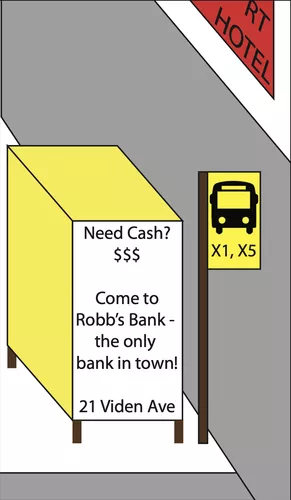
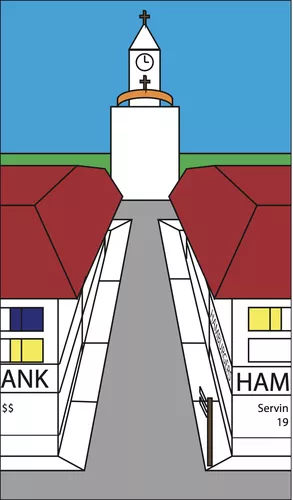
It wasn’t until early 2017, more than year later, that I would arrive at a new prototype that bared some resemblance to the final game. There were 24 cards, clumsily adorned with illustrations I had put together in Illustrator (see below), which were dealt out evenly between the players. Using the information on these cards that depict a fictional city, players had to answer a number of questions about a crime that had been committed.
There was only one rule, which has stayed throughout the entirety of the game’s evolution: Players are not allowed to show each other their cards. Apart from this, no restrictions exist on communication, and players can describe what’s on their cards as they wish, even reading some things verbatim. This ownership of information meant that the game wasn’t just about solving a mystery; it was also about communication, something new compared to the solo experience of Her Story.
Even though my limited illustrative ability made the mystery much more difficult that I had intended, playtesters really enjoyed the experience, especially the simplicity of the game system. You got those “a-ha” moments when one player would describe a feature on one of their cards and suddenly another player would search through their cards to find the one that contained a detail they had previously dismissed as irrelevant, only to have been given new context by what the other player had said. Players would bounce information between one another, leading them from card to card and increasingly understanding what was going on, giving order and meaning in what initially had been cards with a set of seemingly random information.
With this initial case designed and me now content with its progress, I started on the journey to find a publisher for the game. Seeing how even small issues with my illustrations would lead to huge misunderstandings, I knew I would need a publisher with resources for the high standard of illustration the game would need. I also needed one who could put the game through rigorous development — the problem with narrative games is that you soon run out of available playtesters as each can meaningfully test a given scenario only once!
I tried Space Cowboys first as by this time it had established itself as the leader in such games after T.I.M.E Stories and Unlock! — and while they liked the game, they ultimately passed given that they already had a lot of work supporting the other two game lines. Thankfully, in Nürnberg in 2017 I had an excellent meeting with Repos Production, who decided to sign the game.
Around this time I had met Dave Neale at the Cambridge Playtest group, and he had been bringing along what would eventually become The Baker Street Irregulars, the latest box in the Sherlock Holmes Consulting Detective series. To this day I haven’t met a designer quite like Dave – he approaches design in such a unique way, with a knack of entwining deep storytelling into everything he makes.
With Repos and me trying to develop Perspectives, I knew that given the enormity of the task – especially designing new scenarios — that having Dave on board would be amazing for the project. I asked Dave to join me, and thankfully he agreed to sign on as a co-designer. Apart from watching that first video from Game Maker’s Toolkit, meeting Dave was the most important thing in getting Perspectives to the final game you see today.
After this point, we got to work designing new scenarios with Repos. Probably the main mechanical change was the move to a four-act structure in which the first three acts were self-contained with their own cards and questions, and the last act required all the players to use all the cards from the previous three parts, making these cards visible to all players to solve a final set of questions. It allowed the story to progress within each case, and Dave had a knack for coming up with some amazing twists for “Part 4” of each case.
Despite the game being pretty well developed at this point, sadly it fell into a bit of a publisher limbo, with no real idea of when it might see the light of day. We knew the game was going to need a huge investment of time and money from Repos, especially considering the need for detailed and high-quality illustrations on over one hundred unique cards, so we were happy to wait.
Then we heard that Repos was being bought by Asmodee, and the game entered a different kind of limbo as Repos adjusted to being a studio within a larger group. At this time, the game moved to Space Cowboys, who thought the design could be a good fit for its line. So it might have taken five years after my initial pitch to them, but finally Perspectives had found its rightful home.
Speaking of which, we have been so fortunate to work with Space Cowboys. The care and attention to detail can be seen in so many aspects of the final product, care and attention that is absolutely necessary to provide the intended experience for players. One illustration out of place and suddenly a scenario can become confusing or even unsolvable, and thus a huge thanks needs to also go to the three illustrators – ann&seb, Vincent Dutrait, and Looky — who patiently worked with us over many iterations and alterations. I’m so happy with how the final box has turned out.