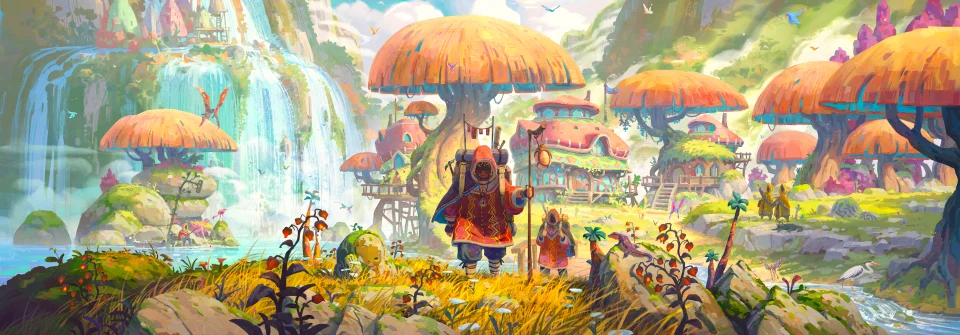
Dewan was released in stores on January 23rd. It took over a year to finalize the development within the studio. Aside from the two designers, Johannes Goupy and Yoann Levet, and the illustrator, Arthus Pilorget, who else was part of the team? Who was working on the game development? We tell you everything!
Who was working on the game development?





And also Vincent G., Head of Creations, Thomas C. – Developer, Léo – Graphic Designer, Jérôme & Angelina – Proofreaders and Translators, and a whole bunch of other people from the studio whom we’d like to say hello to in passing 😉
Is there an aspect of your work that people are unaware of?
SOURCING
Mr. François: The hundreds of emails that need to be answered (with a great deal of forgettable proposals).
PROJECT
Cyprien: The constant balance to maintain within the team and throughout the project so that everyone can contribute their ideas, be listened to, so that the studio delivers a game that is as close as possible to the initial ambitions validated with the designers!
ARTISTIC
Thomas D.: The ergonomics of the equipment and the Research & Development regarding iconography.
Caroline: Contrary to popular belief, illustrators rarely handle the layouts, logos, or even the icons for games! It’s more the graphic designer’s job to highlight the illustrations.
DEVELOPMENT
Cyril: You might think a game arrives “turnkey” at the publisher’s. In reality, it goes through a crucial development phase. The developer’s goal is not to transform the game but to reveal it in its best possible version. In the initial prototype, some actions were free while others cost money. On paper, it seemed to work. But during testing, a strategy emerged: it allowed one player to finish the game too quickly, leaving the others blocked. The solution? Some actions had to be paid for, costs had to be harmonized, and the experience had to be rebalanced. Another example: the fire scoring system. Initially based on comparisons between neighbors, it became hard to follow with four players. The mechanism was simplified to make the score easier to read and more in line with the game’s spirit: accessible yet deep. These are small adjustments. But together, they change everything.
MANUFACTURING
Stéphane: Finding the right support/format/materials to enhance the art, support the ergonomics, and improve the gaming experience without burning the budget while remaining somewhat eco-friendly.
Thibaud & Jeanne: Anticipating all possible risks at the game’s release. This means also developing a basic understanding of everything involved in the creation, production, and distribution of our games. Our role isn’t simply to check schedules and enter orders, but rather to support and coordinate all stakeholders, including the Studio, Distribution Units, and Manufacturing.
MARKETING
Camille: People often imagine that marketing comes in at the end of a project, “to do the promotion.” In reality, we’re involved very early on. On Dewan, we worked from the very first versions to understand the game’s true promise and who it was specifically aimed at. This allowed us to work upstream to differentiate it from all the other games released every year (and there are many).

What was the biggest challenge you encountered on this project?
PROJECT
Cyprien: Sticking to the schedule while allowing ourselves to question the game’s development multiple times to modify, adjust, and create a coherent box, contents, and gaming experience.
DEVELOPMENT
Cyril: The biggest challenge in developing Dewan? The scenarios. The base game already worked very well; it didn’t need to be “fixed.” But could we go further? The idea was to introduce events that genuinely change the way you play: a volcano, a flood… Natural disasters that transform the board and impose new constraints. The goal wasn’t simply to add a thematic layer. We had to craft truly different experiences while keeping compatibility with the core mechanics. It’s a delicate balance: changing enough to surprise players without breaking what gives the game its strength.
ARTISTIC
Thomas D.: Develop a universe and a theme related to the game mechanics.
Caroline: The layout of the rules! They’re not that complex, but the first drafts of the layout were “scary.”
MARKETING
Camille: The biggest challenge was adopting a different strategy from our usual launches. Traditionally, a game is revealed relatively close to its release. For Dewan, we chose to lay the groundwork well in advance. The goal wasn’t simply to announce a game, but to build anticipation. It was a gamble. Showing a game earlier also means accepting that it might still evolve. But this anticipation allowed us to transform the launch into the culmination of a gradual build-up, rather than just a one-off announcement. Dewan wasn’t “announced”: it was anticipated.
MANUFACTURING
Stéphane: To ensure we have supplier samples of the different iterations of the Tribe boards on time for a real editorial study and thus deliver the V1 and V2 prototypes within tight deadlines for marketing and subsidiaries.
Thibaud: Forecasting production scenarios based on the game’s success to prevent stock shortages.
Jeanne: I only got involved in the project after the new game had gone into production. The challenge within my scope concerned the supply of materials. Some components need to be produced well in advance, which means being able to anticipate what our Distribution Units will need and coordinate that planning. It’s difficult to know whether the quantities produced in the first print run will be sufficient for the market, and you have to remain responsive and available in case of last-minute reorganizations.
Is there a detail or decision that you are particularly proud of?
SOURCING
Mr. François: Having successfully conveyed my enthusiasm to the teams (but sometimes, one fails).
PROJECT
Cyprien: I was lucky enough to work with a legendary team for my first Space Cowboys project: from the designers (Johannes Goupy, Yoann Levet) to the illustrator (Arthus Pilorget), including the development duo Cyril Damaegd/Thomas Cauet and an art direction led by Thomas Dutertre/Caroline Sebayhi! I haven’t forgotten the others, of course, but it would take too long to list them all.
ARTISTIC
Thomas D: To work with Arthus Pilorget in order to develop the graphic universe.
Caroline: My adorable little fish tokens. I even hid a dinosaur in the game…
DEVELOPMENT
Cyril: For Dewan, the goal was to verify the game’s balance. We played hundreds of games, tested different tile values, and thus measured win rates according to configurations. If a player wins 40% of the time, there’s a problem. If everyone wins around 25%, the balance is good. This work, completely invisible to the players, is nonetheless fundamental. It guarantees that victory will depend on your choices… not on a hidden imbalance.
MANUFACTURING
Stéphane: To allow the team’s creativity to express itself without restricting it and to be able to offer quality materials to our players.
Jeanne: Beyond this particular game and across all the incredible projects teams are engaged with, I feel very lucky to work alongside such passionate groups. As a logistics specialist, opportunities to participate in projects like these are rare. My pride comes from browsing game stores, discovering a game, and thinking, “In my own small way, I helped make this happen!”
MARKETING
Camille: I’m especially proud of the Christmas party we hosted. The goal was to showcase the Dewan experience in a relaxed environment, with the designers on hand to discuss the game’s origins and connect directly with journalists.
The tables were full all the time, and people kept playing game after game. You could feel the genuine enthusiasm, not just politeness. It was at that precise moment that we understood the game had real potential. Not just because it worked mechanically—we already knew that—but because it sparked an immediate desire to play again and talk about it. This is when Dewan went from “project in development” to “the game that will mark its launch.”

Do you have a memorable experience related to this project?
Mr. François: A wonderful adventure, since it was my first game sourced for Lab4games.
Cyprien: An unforgettable experience!
Thomas D.: A very beautiful adventure!
Caroline: Ongoing graphic learning!
Camille: I could almost sum it up in one word: obvious. It’s rare to have a project where everything seems to align: the mechanics, the theme, the team, the timing.
Stéphane: Pure bliss! Great people to work with.
Thibaud: What a pleasure to work on such a motivating project!!

BEHIND THE SCENES
Who came up with the idea of having several characters appear equal to the victory points on the Story tiles?
Cyprien: The origin of ideas sometimes fades over time; I know it originated during a discussion with Thomas D. We really aimed to fully develop a strong concept for the Story tiles because it was one of the few places where we could showcase Arthus’s creativity (besides the cover, of course). It’s worth noting that, beyond the characters associated with the tile’s victory points, there are also as many light sources as fires on the tiles. Depending on the terrain and resources needed for each tile, those light sources are included accordingly. This creates complete consistency between what the game requires/gives and what the illustrations depict.
Who came up with the idea of a nod to Take Time?
Cyprien: There are five tiles in the game on which we had to place “artifacts.” The idea behind the artifacts was to show that Dewan’s world was our distant world after a possible cataclysm, in which nature had reclaimed its rights. On one of the tiles, the Dewans discover a giant clock while searching. It turns out we had initially planned for Big Ben, and then realized we had written a brief that echoed Take Time, which was being developed at the same time by Libellud. So it’s a happy coincidence!
How did you go from First Culture to Dewan?
Cyprien: We took the letters of First Culture, mixed them up, and… no. There were many meetings and discussions to find a more accessible and punchy title, and not necessarily an English one. Among the suggestions, Day-One was mentioned, and I remember scribbling and dissecting the syllables to bring this English title towards something that sounded and was spelled more “tribal”: Day One, Daywan, Dewan! Incidentally, the game’s title became the name of the people embodied by the players.
Who came up with this theme?
Cyprien: Thomas D. was in charge, and we worked closely with Vincent (our big chief) to avoid certain thematic pitfalls and maintain a clear direction. The main keywords we kept in mind were: Post-apocalyptic, Feel-good, Nature, Colorful World, Mysterious but not fantastical (in the sense of magic, etc.).
How was the illustrator found?
Cyprien: Thomas D. suggested several artists, including Arthus. We all fell in love with his creations, and we were incredibly lucky that he was available during the project period!
How were the scenarios invented?
Cyril: Inspiration can come from… an ant invasion! Creation doesn’t always follow an academic path. The flood scenario was born from a very real situation I experienced: an ant invasion that was impossible to stop… until a torrential downpour solved the problem. What if a flood were to disrupt the game board? As is often the case in creation, an everyday observation can become a fun game mechanic.