

Artistic Background and Practice
I’ve been drawing since childhood and initially had a strong interest in animation. After studying at the Beaux-Arts in Saint-Étienne, my artistic practice evolved to include both site-specific and studio work. This is an ever-evolving process, never truly finished, in which I place great importance on observation. I mainly use watercolor, graphite, and ink as my mediums.
An approach centered on observation
Over time, I have drawn inspiration from various artists and have increasingly adopted the practice of observational drawing and sketching from life, especially in watercolor “en plein air.” This process involves a balance between research and observation: it includes raw sketches and forms captured in motion, leading to a gradually deepening understanding.
I draw nearly every day and sometimes travel for several days to specific locations, depending on what I want to explore and confront in my work.
Research and Documentation for the Project
For a project like this, I started with extensive research, cross-referencing various sources to familiarize myself with the subject, find inspiration, and maintain a scientific yet realistic approach.
I relied on the work of expert illustrators I admire, such as Douglas Henderson, as well as on scientific studies, documentary reconstructions, museum visits, 3D models, and discussions with the Space Cowboys team and paleontologists.
The availability of references varied depending on whether the species was a dinosaur or a mammal.
Working Method and Illustration
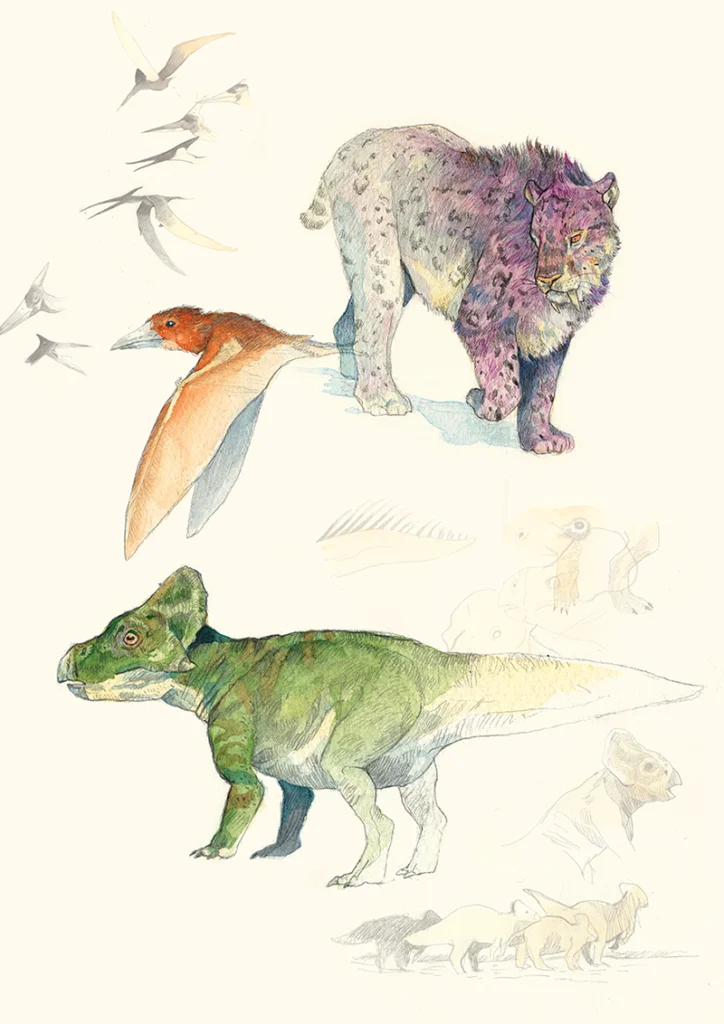
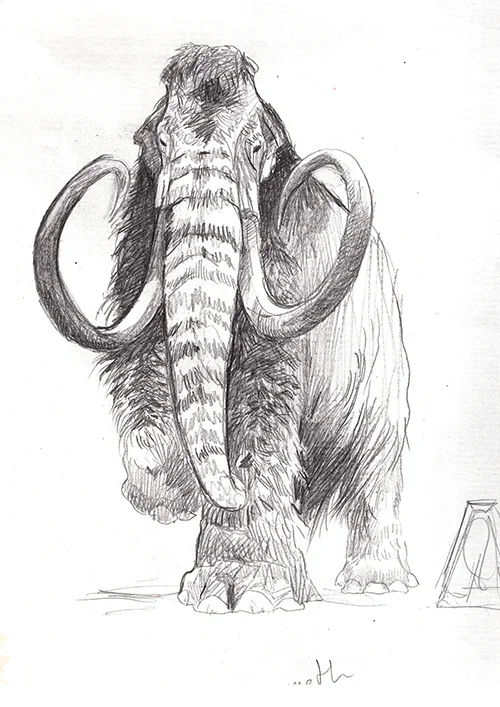
Throughout the project, I approached my work as if I were in the field, sketchbook in hand, using a naturalist style. I started by making quick, spontaneous sketches to capture shapes and movements. Then, I refined the main illustration, focusing on the poses.
The coloring is done with watercolors, applying a layering technique. I intentionally left some areas unfinished to keep a sense of spontaneity.
Working on skeletons
Working on skeletons, especially their bone structure, requires a high level of precision. We consulted with the team beforehand to ensure that the illustrations maintained a level of expressiveness, whether through pose, framing, or stance.
To achieve this, I concentrated on dynamic poses to avoid an overly static appearance, drawing inspiration from my observations of various skeletons in multiple museums.
For example, the T. rex shown on one of the cards is named Trix and is depicted in a hunting stance, while the Triceratops is Big John, the largest known Triceratops.
Jessica Cognard