
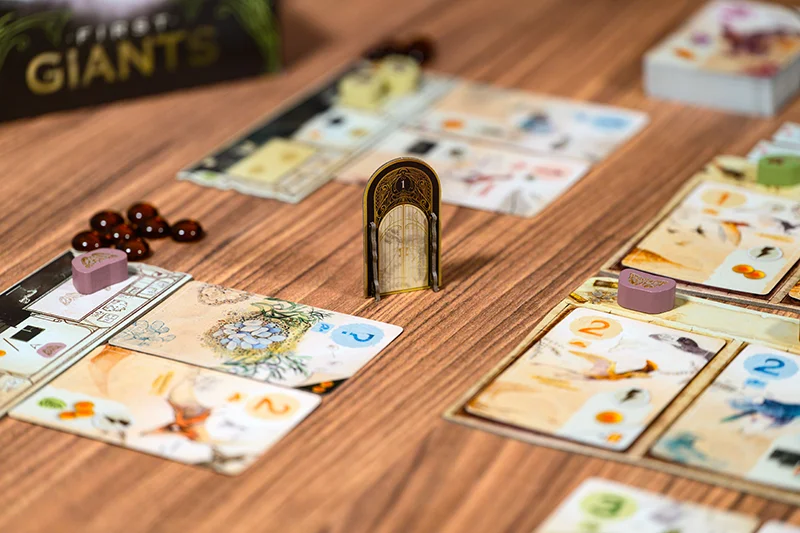
When you look at First Giants, the dinosaur museum theme might seem like an obvious choice. Dinosaurs are cool, museums are elegant; what’s not to love? But the truth is, we didn’t pick dinosaurs (only) because they looked good on a box cover. We picked them because, after months of exploration, they were the only theme that truly worked.
Let us explain.
For some game, theme is mostly like picking an outfit: find something attractive, dress up your mechanics, and you’re done. But when a theme truly serves the mechanics, it does something much more powerful: it teaches the rules before players even read them, it makes decisions feel natural, and turns abstract choices into intuitive ones.
First Giants has very specific mechanical needs, and we quickly realized that not just any “collection” theme would do.
Collections That Don’t Mix
In First Giants, players build sets of cards in two ways: by matching the same family, or by matching the same size. Crucially, these two dimensions must never feel interchangeable. A set of three marine (blue) cards of different sizes makes sense. A set of three medium (2) sized cards from different families makes sense. But a big marine (3 blue) fossil in the same collection as a small carnivore (1 red)? That should feel wrong instinctively, without anyone needing to explain why.
This is harder than it sounds.
We explored many themes that seemed promising on paper but collapsed under this constraint:
• Legends (Greek, Viking, Japanese mythology…) were our first instinct, given Elysium’s origin. But it was too close to the original game’s identity and very expert-oriented.
• Herbarium (pressing and collecting plants). Botanically, families and sizes exist, but the theme felt mechanical. Cold. There was no emotional pull, no wonder. Players didn’t light up when we described it.
• Planetarium (celestial bodies, constellations, cosmic phenomena, and so on) Same issue: scientifically sound, but emotionally sterile. Too abstract, too distant.
• Restaurant / Food / Cooking: here the problem was the opposite. Food wants to be mixed. The whole joy of cooking is combining ingredients from different families. A tomato next to a basil leaf next to mozzarella? That’s not a mistake, that’s a caprese salad. Some people even put pineapple on pizza… The theme actively worked against our mechanic.
• Movies / Books: same trap. A great film collection is eclectic. You want a thriller next to a comedy next to a documentary. Curating across genres is a feature, not a bug. Again, the theme fought the game instead of serving it.
Then someone said dinosaurs, and the more we work on it, the more everything clicked. A Tyrannosaurus and a Triceratops are obviously different families: no one would ever confuse them. And within a family, size differences are immediately legible. Plus, it makes sense to have each size be linked with the 1/2/3 cost to transfer them: obviously displaying a Diplodocus will be more expensive than a Trilobite. The taxonomy is intuitive, visual, and, critically, it matches exactly how our sets work in the game.

Two Lives For Every card
First Giants inherits Elysium’s unique “engine unbuilding” tension. Cards exist in two states: first they’re active, fueling your engine with powerful effects. Then, at a moment of your choosing, you expose them into your collection, where they score points but lose their abilities.
This dual life is the heart of the game, and the theme needed to communicate it clearly. Players should feel the difference between the two states without checking the rulebook.
Having something that is alive, then dead, is a very powerful metaphor for this. We already knew how powerful it could be: ten years ago in Elysium, heroes had to die to become legends.
The museum concept takes this idea even further, giving you two distinct spaces that mirror each state: your cards begin in your study, a researcher’s workspace, where dinosaurs are alive in your imagination, actively being investigated, producing scientific insights. Then, when you’re ready, you move them into your exhibition, a public display, prestigious but static. The dinosaur is no longer a living research subject. It’s a mounted skeleton. A finished piece. Done.
That emotional shift, from living science to silent display, mirrors the mechanical shift perfectly.
Make It Visible
This is where art direction completed the puzzle. We needed players to see the difference between the two card states at a glance, from across the table.
Cards in your study feature vibrant watercolor illustrations rendered in Jessica Cognard’s naturalist field-sketch style, with a strong color filter that helps the family read clearly. They feel alive, dynamic, in progress.
And when a card moves to your exhibition? It becomes a fossil. A stencil-drawn skeleton on a dark background. The color drains away to a faint light; the creature is preserved but no longer breathing. The card is “dead” mechanically and visually.
This isn’t just aesthetic polish. It’s functional communication. When you glance at your tableau, you instantly know what’s active and what’s scored, what’s still working for you and what’s been locked away behind glass. No icon needed. No reminder tokens. The art is the information.
A Theme That Earned Its Place
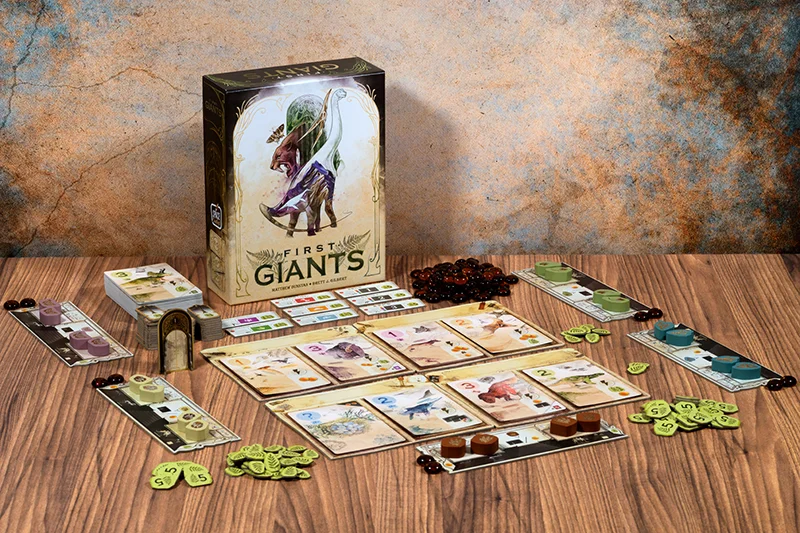
We’ll be honest: this theme was polarizing, and some wanted it out of the list. But the more we worked on the game, the more it became clear that this was the right one.
Dinosaurs gave us families that don’t mix. Sizes that feel natural. A two-state metaphor that players grasp immediately. And an art direction that communicates game state without a single word.
This article is already long enough, and there’s still so much we haven’t told you: how the petrified green half-laurel and the round, warm, yellow amber became the most intuitive victory point token and currency we’ve tested. How we matched each dinosaur family to mechanics that just make sense: the yellow family interacts with amber, the green one with points, and, obviously, mammals interact with other players… But we’ll let you discover those connections for yourselves. After all, the best part of any dig is what you uncover on your own.
Domitien, Lucas and Joeva
Development team