
While developing First Giants, we collaborated with paleontology science communicators Amy Beauvois and Jonathan Lafont to ensure the game is both enjoyable and scientifically accurate based on current knowledge of prehistoric animals. We also partnered with them to answer many of your questions on the topic, and you can explore the results on this blog.

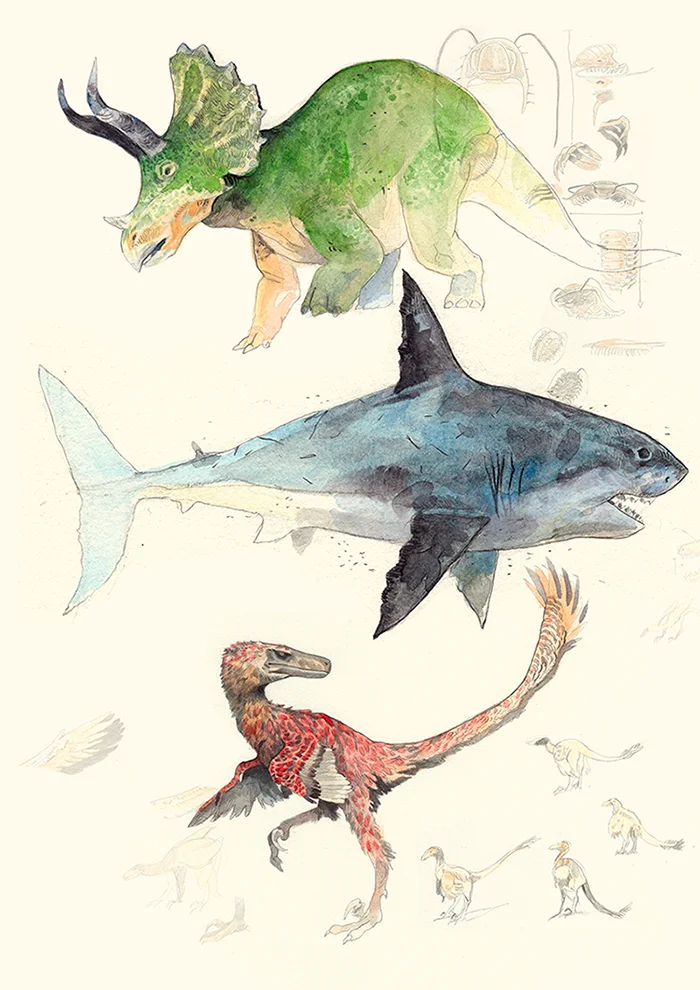
How can we determine the colors of dinosaurs?
Amy :
In most cases, the colors of dinosaurs remain unknown. Although paleontologists have found skin fossils, they are usually skin impressions rather than actual skin.
In very rare cases, melanin may become fossilized. This pigment determines whether skin looks lighter or darker, depending on its concentration. In such instances, comparing these fossilized components—and their amounts—with those found in modern animals helps us estimate the color of the skin being examined.
This is known as actualism. It is a fundamental principle of paleontology: using present-day observations to understand the past. In reality, we do not have perfectly defined colors. Most often, scientists have only a relative idea—such as whether the skin was lighter or darker —based on shades of gray, brown, or ochre. As a result, the exact colors of dinosaurs remain somewhat speculative, even in these instances.
It should be noted that we have a good idea of the coloration of most feathered dinosaurs. Here are a few well-known examples:
- • Microraptor: Feather coloration similar to that of a blackbird, featuring iridescent feathers.
- • Sinosauropteryx: Feather coloration with a white-and-ochre pattern along the tail and an ochre mask around the eyes.
- • Psittacosaurus: Scale coloration featuring a classic herbivore camouflage pattern—dark on the back and light on the belly.

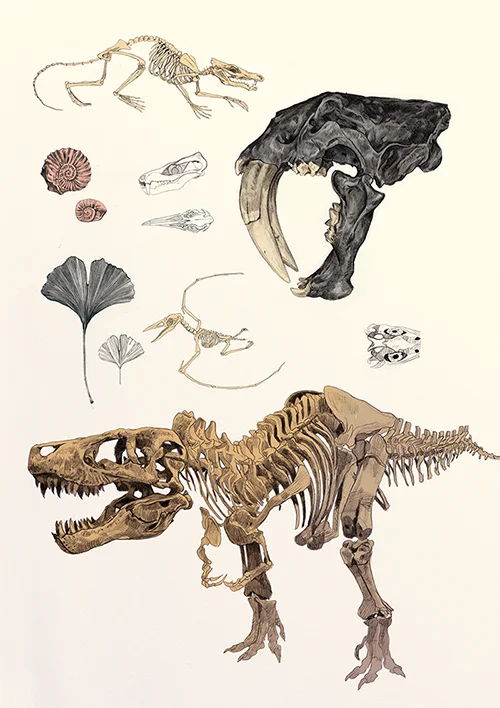


Why is there a distinction between avian and non-avian dinosaurs?
A crucial point to remember: birds are not the descendants of dinosaurs; they ARE dinosaurs. Some groups of modern birds already existed while T. rexes were still alive.
Amy :
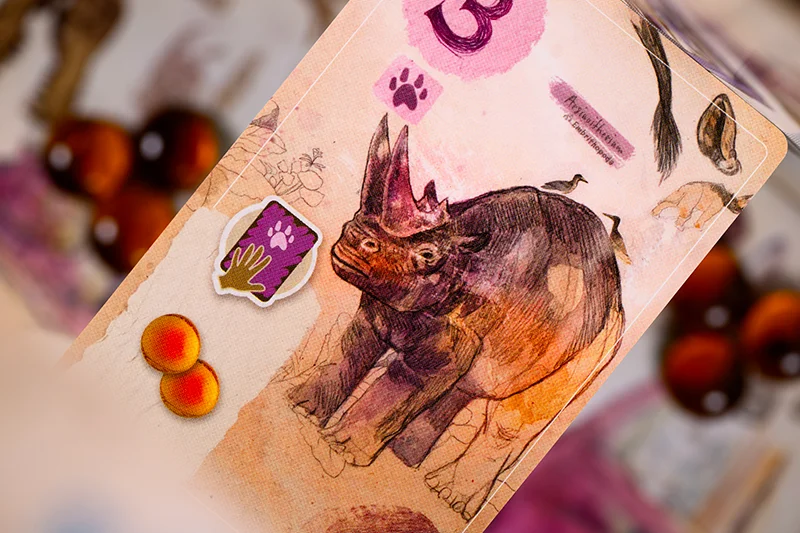
Birds, classified as avian dinosaurs, originated in the Middle Jurassic. Although it is common to distinguish “dinosaurs” from “birds” linguistically, in reality, birds are a subgroup of dinosaurs—much like humans are a subgroup of animals.
We use the label “bird” as a descriptor to clearly indicate the animals’ status, in line with our standard definition of a modern bird. This prevents us from excluding them from the dinosaur group. Similar phrasing is used elsewhere—such as “non-human primates”—to avoid establishing an arbitrary boundary based on a human perspective of the animals’ evolution, while still emphasizing the distinction from contemporary birds.
And from a practical perspective, modern birds are vastly different from other dinosaurs and account for only a small part of overall dinosaur diversity. For example, flight has led to many anatomical changes.
It’s also important to note that modern birds are the only dinosaurs—and indeed the only birds—to have survived the end of the Cretaceous period 66 million years ago. They make up a tiny part of the group’s overall diversity. Before the extinction of other dinosaurs, birds were just one of many dinosaur groups. Their closest relatives, the “raptors” (a family that includes the well-known *Velociraptor*), blurred the distinction between “birds” and “other dinosaurs” as we understand it today.
Did dinosaurs have feathers?
Jonathan :
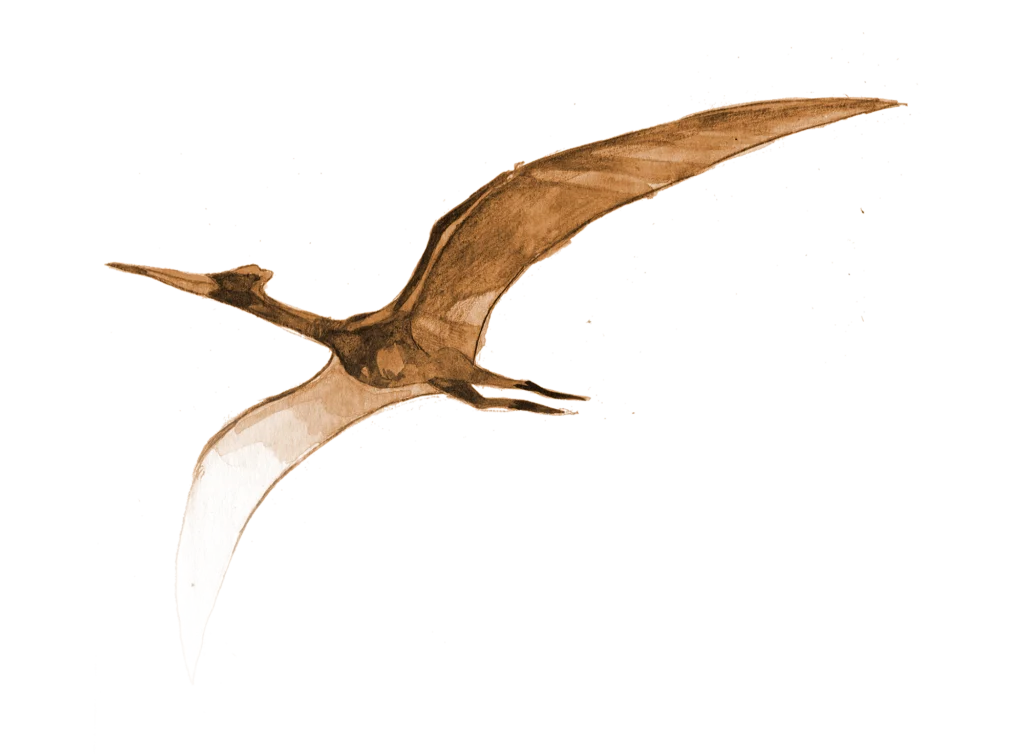
We can confirm that YES, dinosaurs had feathers—and indeed that dinosaurs HAVE feathers—because all current bird species are dinosaurs.
The connection between “birds” and “dinosaurs” is not a recent discovery. By the time Charles Darwin published On the Origin of Species in 1859, scientists had found a dinosaur fossil dating back to the Jurassic period, 150 million years ago. It was named Archaeopteryx, which means “ancient wing.” It was the first fossil discovered to show traces of very well-preserved feathers.
Note that Archaeopteryx is not a bird in the strict sense of the word. It is a dinosaur with typical characteristics: a long tail, claws, and teeth. However, it also shares features with birds—such as an identical pelvic structure and forelimbs that were beginning to turn into wings.
Starting in the 1990s, paleontologists discovered new dinosaur fossils displaying preserved traces of feathers.
One notable example is the discovery of numerous feathered dinosaur fossils, such as the species known as Sinosauropteryx, in Liaoning Province, China.
In 2007, a team of paleontologists described markings on the forearm bone of a Velociraptor. These closely resemble the marks left by modern birds’ feathers, indicating that Velociraptors had feathers.
More recently, a fragment of a feathered dinosaur tail was found preserved in amber.
In conclusion, modern-day dinosaurs (birds) all have feathers, and paleontologists have discovered evidence showing that some dinosaurs from the Jurassic and Cretaceous periods also had feathers; however, this does not necessarily mean that all known dinosaurs had feathers.
Did mammals lay eggs?
Jonathan :
In reality, there are mammals that LAY eggs! We currently know of a group of mammals whose offspring are born from eggs. These are monotremes that resemble echinoids and platypuses.
This means that the defining characteristic of mammals is not “giving birth,” even though most do. The defining characteristic of mammals is that they produce milk to feed their young (the term “mammal” is derived from “mammary gland”).
It is possible that the earliest mammals, which appeared virtually at the same time as the first dinosaurs, 239 million years ago, laid eggs. However, no trace of mammalian eggs has been found in the fossil category.
In April 2026, a study reported the first fossil of an embryo belonging to a group that predates mammals. This 250-million-year-old fossil shows a small creature curled up tightly — as if inside an egg — yet without any trace of a shell. Detailed studies revealed that the animal was not fully developed and could not feed itself, suggesting it had not yet hatched.
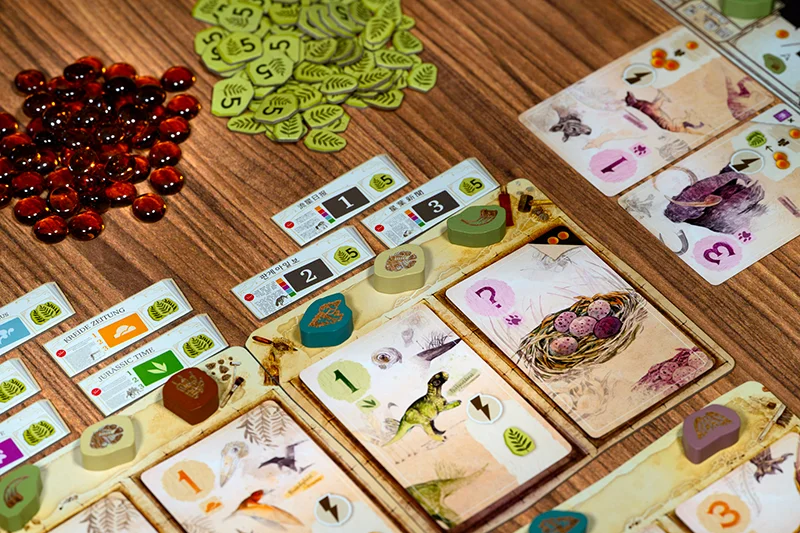
Where is the line between scientific interpretation and speculation in reconstructing dinosaurs?
Any artistic work that recreates a past environment, using existing knowledge and scientific discoveries available at the time it was made, can be called paleoart.
Amy & Jonathan
All paleoart works are, by definition, inaccurate. In fact, certain anatomical details cannot be known because they have not been preserved through fossilization—prime examples being the color of dinosaurs’ skin and feathers, or the sounds they made.
.
The line between interpretation and speculation is complicated because it keeps changing and depends on the amount of information available about the organism. As a result, it doesn’t really exist as a fixed boundary but rather as a gray area where decisions must be justified. Interpretation can depend only on what can be learned from the available fossils of the organism. Because of this, it quickly reaches its limits, making speculation a key part of paleoart.
Furthermore, even when fossil evidence is available, debates over its scientific interpretation can still happen. A well-known historical example involves the dinosaur called Iguanodon: in the 19th century, when the first fossils of this animal were found, paleontologists thought it had a horn on its nose, until it was established that this feature was actually a thumb spike.
It would be hypocritical to dismiss speculation as inherently flawed, since paleontology has relied on it from the very beginning to fill gaps in the fossil record. That said, effective speculation requires a solid foundation in scientific knowledge. Consider feather coverage on a dinosaur, for instance—it must be carefully evaluated based on the creature’s habitat, lifestyle, size, and evolutionary position within its group. When well-reasoned, speculation can blur the line between interpretation and genuine prediction, sometimes even anticipating future scientific discoveries. The Velociraptor is a perfect example: paleontologists confirmed that the animal had feathers on its arms, but the comprehensive feather coverage we reconstruct is grounded in our understanding of related raptor species. Ultimately, the better we grasp how organisms actually functioned, the more compelling and credible our speculation becomes—revealing entirely new possibilities in the process.
Speculation is an inescapable part of paleoart—and that’s perfectly natural given how limited fossil data actually is. While artists certainly have the freedom to make speculative choices that may not be entirely credible, what truly matters is that they’re honest and transparent about it. They should be clear about distinguishing between what’s grounded in solid scientific interpretation and what’s purely speculative.
Amy Beauvois & Jonathan Lafont
Science communicators specializing in paleontology


Sources & references:
- https://www.cell.com/current-biology/fulltext/S0960-9822(17)31197-1?_returnURL=https%3A%2F%2Flinkinghub.elsevier.com%2Fretrieve%2Fpii%2FS0960982217311971%3Fshowall%3Dtrue
- https://pmc.ncbi.nlm.nih.gov/articles/PMC5049543/
- https://web.archive.org/web/20180831072106/https://pdfs.semanticscholar.org/58f0/0bcda8da889ba578e944e91eb8f336e934db.pdf
- Mayr G., 2017. Avian Evolution: The fossil Record of Birds and Its Paleobiological Significance. Wiley Blackwell, 293 pp.
- https://naturalhistory.si.edu/sites/default/files/media/translated_publications/Ji%26amp%3BJi_96.pdf
- https://www.science.org/doi/10.1126/science.1145076
- https://www.futura-sciences.com/planete/actualites/paleontologie-queue-dinosaure-plumes-99-millions-annees-retrouvee-ambre-33474/
- https://www.cell.com/current-biology/fulltext/S0960-9822(16)31193-9?_returnURL=https%3A%2F%2Flinkinghub.elsevier.com%2Fretrieve%2Fpii%2FS0960982216311939%3Fshowall%3Dtrue
- https://www.radiofrance.fr/franceculture/podcasts/avec-sciences/un-fossile-d-oeuf-decouvert-pour-la-premiere-fois-chez-un-pre-mammalien-6199893
- https://www.futura-sciences.com/planete/actualites/mammifere-cet-oeuf-vieux-250-millions-annees-repond-enfin-vieille-question-nos-ancetres-mammiferes-133748/
- https://journals.plos.org/plosone/article?id=10.1371/journal.pone.0345016
- https://palaeo-electronica.org/content/pdfs/comment_palaeoart.pdf
- https://fr.wikipedia.org/wiki/Pal%C3%A9oart